unfamiliar agencyUpdates and research notes for my thesis.2026-04-16T00:00:00Zhttps://unfamiliaragency.neocities.org/Dan McCurleydjmccurley@gmail.comWeek 12 Update2026-04-16T00:00:00Zhttps://unfamiliaragency.neocities.org/posts/6100-week-12/<p>This week I worked on completing a rough proof of concept for the driving/bidding/shopping game. This meant getting the functionality and physical inputs to work and not conflict with each other. My goal is to have all three interactions be simultaneous, without awkward pauses. This will create the most frantic and overwhelming experience.</p>
<h2>Development Updates</h2>
<p>I cobbled together a scrollable list of placeholder items that will eventually house the shopping part of the game. At first the scrollable list and the text input were fighting for focus – you had to click in and out of them, which was not ideal for the game. I eventually found a fix that keeps the focus in the textbox and just fakes the focus for the scrollable items. That will allow me to keep all the inputs separate for each part of the game and avoid conflicts.</p>
<p>Here’s a demo of the game while driving, scrolling items and typing numbers all at once-ish:</p>
<iframe width="560" height="315" src="https://www.youtube.com/embed/7feS6KG4RHc?si=pD819bNKIbDaJgij" title="YouTube video player" frameborder="0" allow="accelerometer; autoplay; clipboard-write; encrypted-media; gyroscope; picture-in-picture; web-share" referrerpolicy="strict-origin-when-cross-origin" allowfullscreen=""></iframe>
<h2>Physical Devices</h2>
<p>Another bonus this week was finally receiving all my input devices from Amazon/eBay. Here are some notes on getting those set up:</p>
<h3>USB Volume Knob</h3>
<p>The knob worked right away when I plugged it in, which meant that it also controlled the volume up and down while using it in the game - definitely more frantic but not a great experience. I found a video in Mandarin (with English subtitles) that showed how to reconfigure the knob using a blank text file 🤯. I eventually got it working with the game by mapping the knob turns and clicks to F1, F2 and F3 keys (again, to avoid conflicts with other inputs and the text field). The knob will be used to scroll and click the shopping list.</p>
<p><img src="https://unfamiliaragency.neocities.org/assets/images/2026-04-16-20-03-36.png" alt="image of the usb knob config video"></p>
<h3>10-Key Number Pad</h3>
<p>This also worked as expected right away, as it’s a keyboard. Godot easily distinguishes between number pad keys and the top row numbers, so this will be easy to integrate. The 10-key will be used to enter bids for new mowing jobs, in a text/messenger like format.</p>
<h3>USB Steering Wheel and Pedals</h3>
<p>The most satisfying piece of equipment in this setup, the <em>Logitech WingMan Formula GP</em> is a USB steering wheel and pedal controller from around 1999 – 2000. It was also cheap enough on eBay that I could risk it not working with modern computers. To my surprise, the computer recognized it right away, but nothing was mapped to it. A short search led to <a href="https://yukkurigames.com/enjoyable/">Enjoyable</a>, a homespun app for mapping controllers to other keys/mouse events:</p>
<p><img src="https://unfamiliaragency.neocities.org/assets/images/2026-04-16-20-00-59.png" alt="image of Enjoyable app"></p>
<p>27 years later, the wheel and pedals still work! They will drive the lawnmower and add another dimension of frustration with the foot controls.</p>
<h3>Test Setup</h3>
<p>Here’s a photo of the setup after getting it all working. My desk is too thick to clamp the wheel to it, so I’ll need to make some kind of jig or find a new table.</p>
<p><img src="https://unfamiliaragency.neocities.org/assets/images/2026-04-16-20-01-56.png" alt="image of my desk with all three physical devices plugged in"></p>
<h2>Up Next</h2>
<ul>
<li>Creating the behind the scenes mechanics (i.e. the guts of the game).</li>
<li>Creating lo-fi assets for each section of the game.</li>
</ul>
Week 11 Update2026-04-11T00:00:00Zhttps://unfamiliaragency.neocities.org/posts/6100-week-11/<p>This week I began sketching and prototyping for Project 3, the perspective inversion exploration. I began by mapping out the qualities of my last few projects and their opposite polarities:</p>
<table>
<thead>
<tr>
<th style="text-align:left"><em>Recent Projects</em></th>
<th style="text-align:left"><em>Opposite Polarity</em></th>
</tr>
</thead>
<tbody>
<tr>
<td style="text-align:left">Non-commercial</td>
<td style="text-align:left">Hyper-commercial</td>
</tr>
<tr>
<td style="text-align:left">Reflective</td>
<td style="text-align:left">Instinctual/guttural</td>
</tr>
<tr>
<td style="text-align:left">Qualitative/Personal</td>
<td style="text-align:left">Quantitative/Impersonal</td>
</tr>
<tr>
<td style="text-align:left">Calm</td>
<td style="text-align:left">Stressful</td>
</tr>
<tr>
<td style="text-align:left">Non-goal oriented (Atelic)</td>
<td style="text-align:left">Goal Oriented (Telic)</td>
</tr>
<tr>
<td style="text-align:left">Present/Aware</td>
<td style="text-align:left">Distracted</td>
</tr>
</tbody>
</table>
<p>These help map out the end experience I want for the participant: overwhelming, stressful and impossible to manage. However, it also needs to be fun and engaging, at least at first – the player/participant must be willing to enter into the critical dialog in the first place. By embracing the hyper-quantitative and distracted qualities of interaction design, the intervention will aim to generate critical awareness by becoming increasingly terrible to participate in. I can really lean on my previous experience in UX and e-commerce for this project: just do the opposite of everything that's good and holy (or for the corporate-speak crowd: by leveraging worst practices).</p>
<p>My initial sketches for creating this experience involved using multiple, simultaneous points of interaction to create an impossible to manage, always out of control dynamic. After some more ideation, I landed on a concept of simultaneously trying to 1) mow lawns to earn money, 2) spend money buying trinkets online and 3) text with potential clients to line up new mowing jobs. If this was an arcade game, it could look something like this:</p>
<p><img src="https://unfamiliaragency.neocities.org/assets/images/2026-04-11-17-22-00.png" alt="sketch of multiple interactions in one game"></p>
<p>I committed to the approach buy purchasing a used USB racing wheel, a 10-key number pad and a USB volume spinner/button that will serve as the controls for the game. While I wait for those to arrive, I started testing prototype interactions in <a href="https://godotengine.org/">Godot</a>. I got a little bogged down trying to figure out how all the game mechanics and systems would work together, which felt dispiriting. I jotted down some loose notes before deciding that I should just start coding the thing and I'd figure out the guts later.</p>
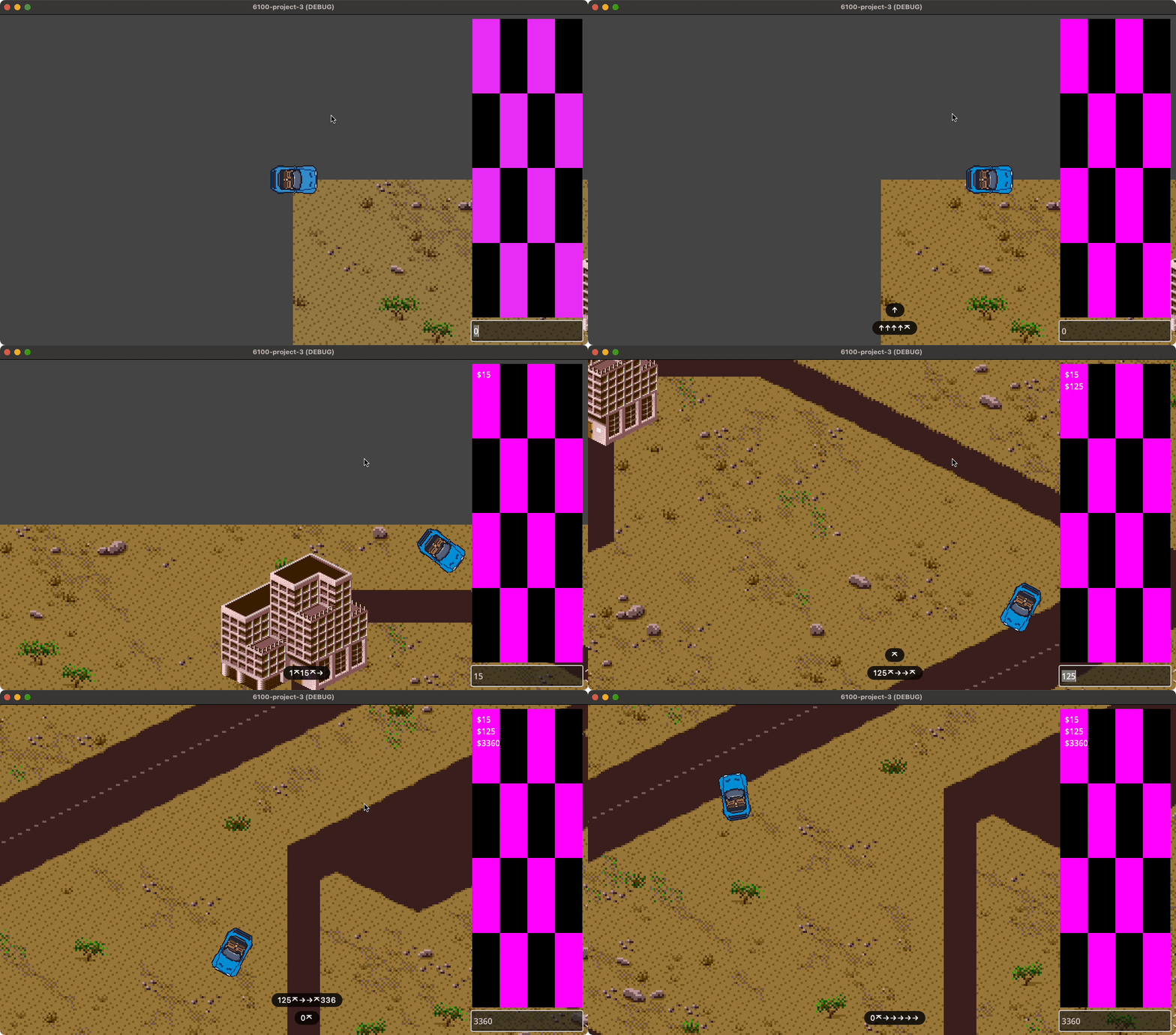
<p>My new goal for the week was to get something working in Godot and see if I can control multiple parts of the game/UI at the same time. I found a prototype that I made last summer while learning Godot: it's a top-down driving prototype for a car game. With a little moxie, it could also work as a mowing game. I added a number input and a text placeholder to try passing number values from the keyboard to the UI. So far everything is working, and the next goal would be to add a scrollable list of things for the shopping mechanics. Driving and typing numbers at the same time already feels impossible, so I think it's on the right track.</p>
<p><img src="https://unfamiliaragency.neocities.org/assets/images/week-1-poc.gif" alt="week 1 POC progress - driving and typing numbers at the same time"></p>
Perspective Inversion2026-04-10T00:00:00Zhttps://unfamiliaragency.neocities.org/posts/project-3-w1/<p>Thesis Prep Studio Project 3 involves finding new conceptual approaches to our thesis topic. The goal is to focus on problem-finding, critical prototyping and learning through making.</p>
<p>A lot of my work focuses on responding to and being critical of implicit biases, specifically those that drive us relentlessly towards linear growth, resource extraction and quantification. This usually involves inviting the participant to reflect on their own agency through non-commercial, atelic, reflective and/or presence-building interactions. These are offered as an alternative to the underlying 'default' forces that run much of our lives.</p>
<p>Instead of rejecting or attempting to counter those forces, what if we embraced them even harder? What if we ramp them up 10000X? How might we use the language, visuals and design of hyper-commercial, goal-oriented, quantitative growth to create a critical dialog? Rather than offering an alternative way of being/doing, this investigation will explore critical design by leaning in to the underlying biases and systems that I've previously been trying to counter.</p>
MERGE2026-04-03T00:00:00Zhttps://unfamiliaragency.neocities.org/posts/merge-collab/<p>MERGE is a co-creative experience rooted in communal sitting, interactive games and storytelling. Designed as an interactive exhibit, participants come together to create new constellations and tell original stories in an immersive environment.</p>
<p>This project began as a collaboration with <a href="https://www.nskhoury.com/">Nadine Khoury</a>, based on our previous thesis-related work. Communal floor-sitting and multiplayer interactive exhibits seemed to go hand in hand. Our initial explorations and sketching led to an interactive experience with four people seated around a large area, collaboratively creating something in the middle. This turned into a literal space (the cosmic kind), with the participants guiding space particles towards each other to co-create constellations.</p>
<p>The interactive experience eventually expanded into a full exhibit, with storytelling and communal sitting at the core. While creating the entire experience was out of scope, the prototype included a fully playable game, a 3D model of the space and an interactive pilot test in the Student Innovation Center.</p>
<p>Process and Background: <a href="https://unfamiliaragency.neocities.org/assets/pdf/merge-process-dm-nk.pdf">MERGE: A Collaborative Intervention [PDF]</a></p>
<iframe src="https://itch.io/embed/4345057" width="552" height="167" frameborder="0"><a href="https://technolumina.itch.io/merge">MERGE by technolumina</a></iframe>
<p><img src="https://unfamiliaragency.neocities.org/assets/images/2026-04-06-12-44-15.png" alt="">
<img src="https://unfamiliaragency.neocities.org/assets/images/2026-04-06-12-44-29.png" alt="">
<img src="https://unfamiliaragency.neocities.org/assets/images/2026-04-06-12-44-44.png" alt="">
<img src="https://unfamiliaragency.neocities.org/assets/images/2026-04-06-12-44-58.png" alt="">
<img src="https://unfamiliaragency.neocities.org/assets/images/2026-04-06-12-45-37.png" alt=""></p>
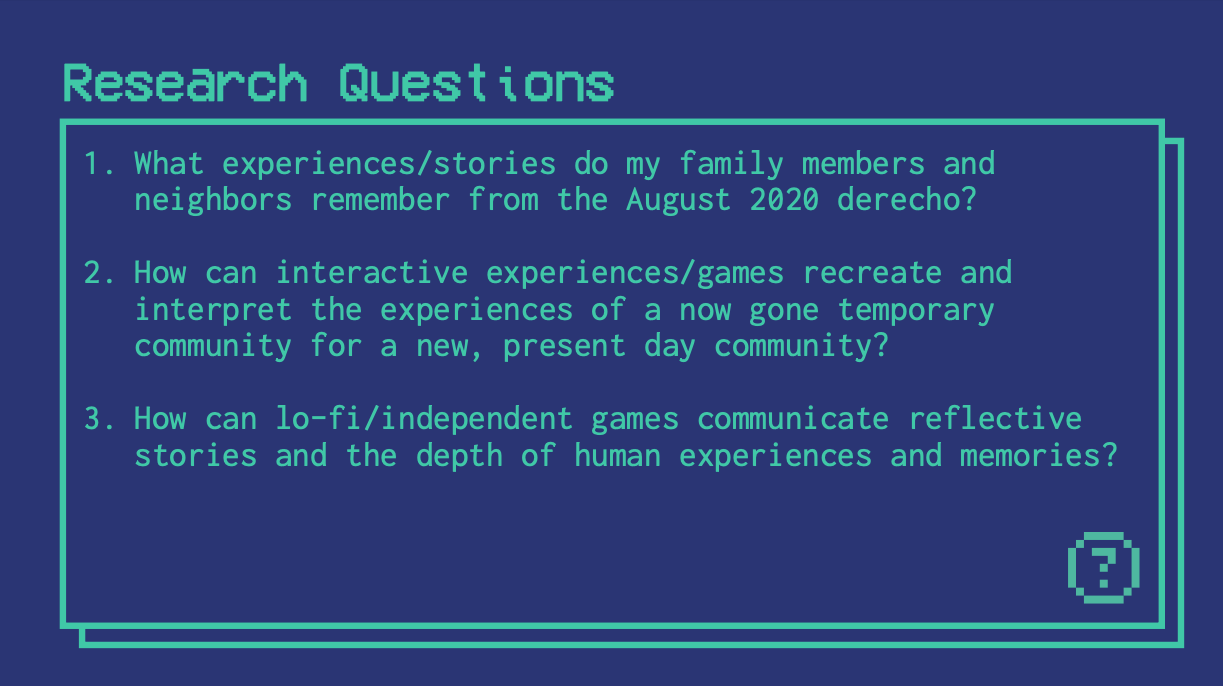
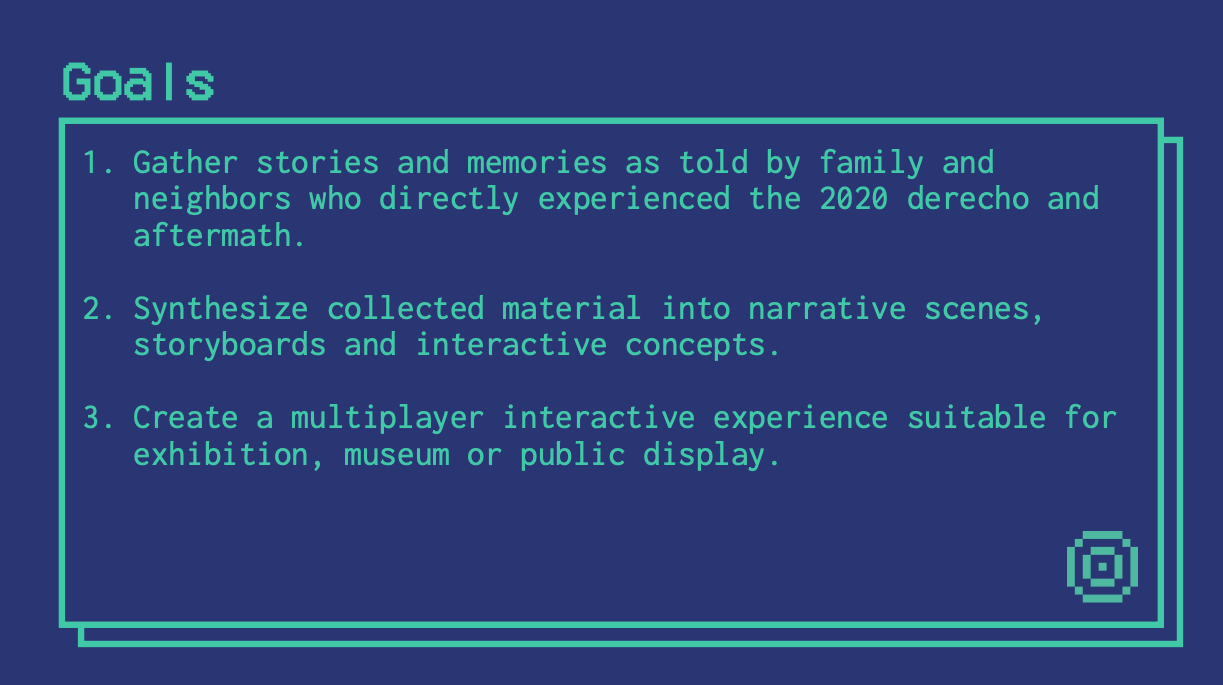
Derecho Communities Proposal2026-04-03T00:00:00Zhttps://unfamiliaragency.neocities.org/posts/6100-project-1/<p>This project involved creating a proposal for a creative inquiry engaging a temporary community. I focused on connecting two temporary communities:</p>
<ol>
<li>The local community that formed in our neighborhood after the August 2020 Iowa Derecho</li>
<li>Present-day exhibit viewers playing a multiplayer videogame</li>
</ol>
<p>The creative inquiry would involve creating an original interactive experience through which present-day players could experience stories and memories collected from the post-derecho community. The project would also explore interactive videogames within the gallery/exhibition context, investigating how shared interactive experiences can help us preserve, share and learn from past stories.</p>
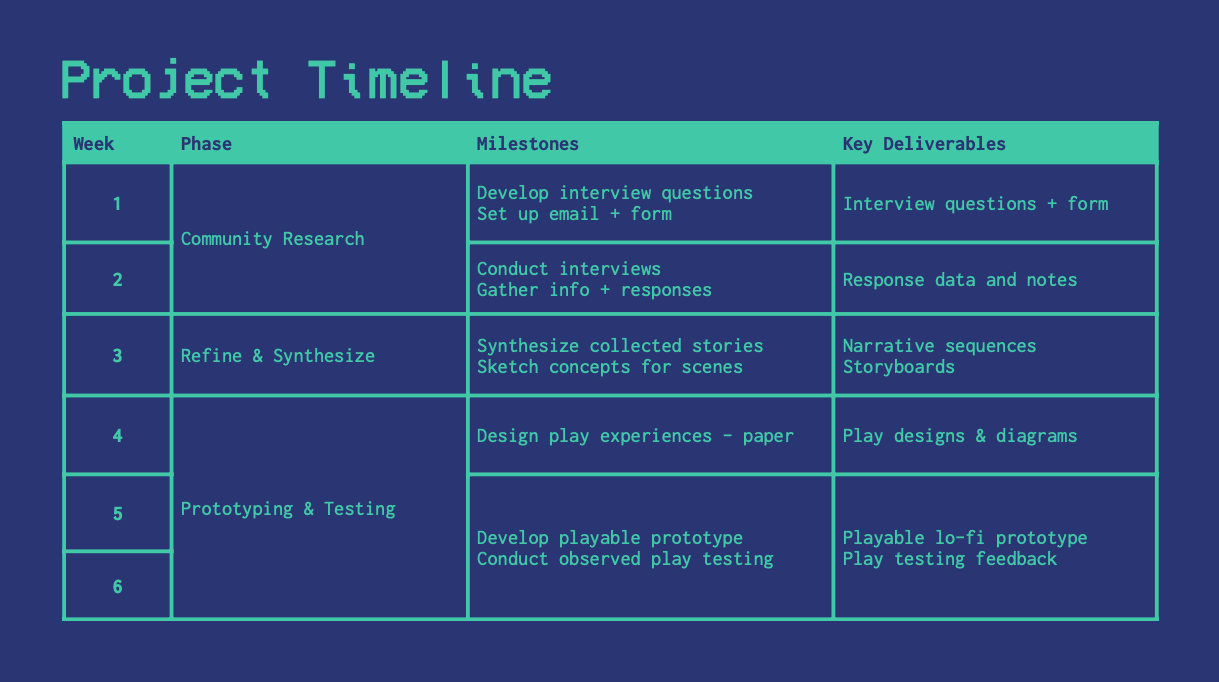
<p>Framing this work as a proposal rather than a completed game helped us think through the logistics and scheduling for a multi-phase project. It also provided good experience articulating research goals and positioning creative inquiry alongside other academic research and externally funded avenues.</p>
<h2>Proposal Details</h2>
<p><img src="https://unfamiliaragency.neocities.org/assets/images/2026-04-04-16-32-25.png" alt="">
<img src="https://unfamiliaragency.neocities.org/assets/images/2026-04-04-16-32-41.png" alt="">
<img src="https://unfamiliaragency.neocities.org/assets/images/2026-04-04-16-32-55.png" alt="">
<img src="https://unfamiliaragency.neocities.org/assets/images/2026-04-04-16-33-13.png" alt=""></p>
<h2>Concept Art</h2>
<p><img src="https://unfamiliaragency.neocities.org/assets/images/deck-1.gif" alt="">
<img src="https://unfamiliaragency.neocities.org/assets/images/gas-1.gif" alt="">
<img src="https://unfamiliaragency.neocities.org/assets/images/neighbor-1.gif" alt=""></p>
Kickoff Collaboration2026-04-02T00:00:00Zhttps://unfamiliaragency.neocities.org/posts/kickoff-collab/<p>Our kickoff project in Thesis Prep Studio was a collaboration across cohorts, i.e. between 2nd year and 3rd year MFA students. <a href="https://gabriellagoldstein.squarespace.com/">Gabriella Goldstein</a> and I were challenged with envisioning for a speculative future scenario and designing artifacts from that future.</p>
<p>We focused on a future in which all pollinating insects have gone extinct. Faced with a collapsing ecosystem, humans are faced with a choice: take up the invisible labor previously done by insects or starve to death. <em>How might humans fill in the ecological roles previously assumed by insects?</em></p>
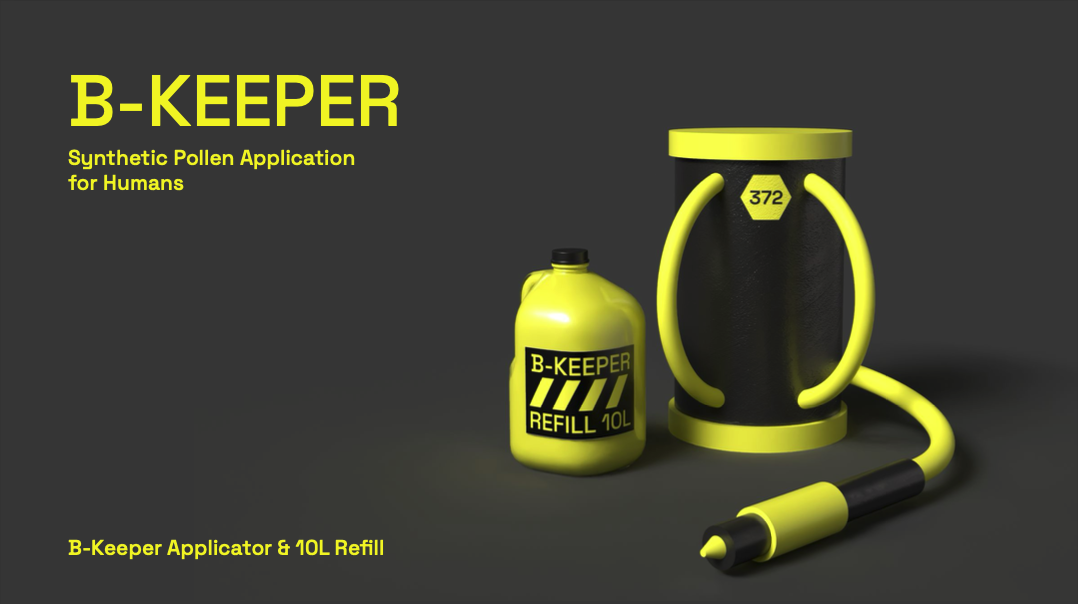
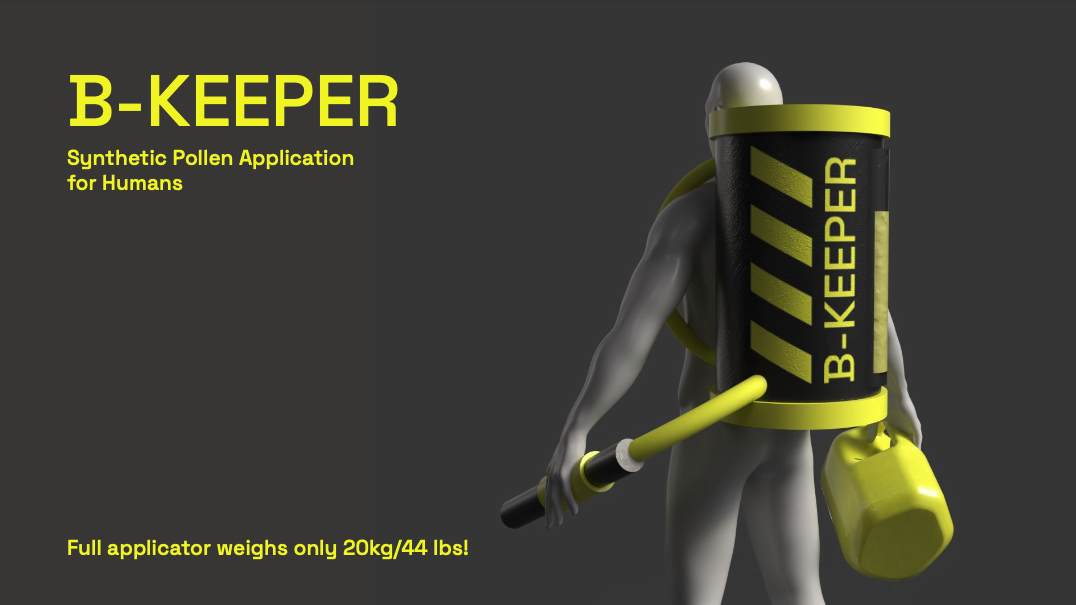
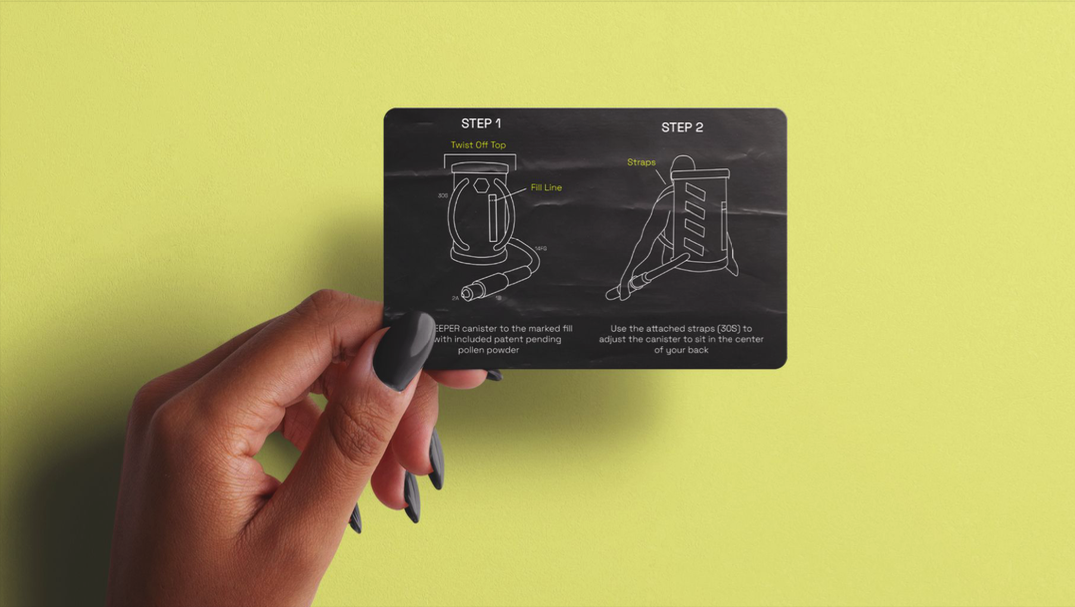
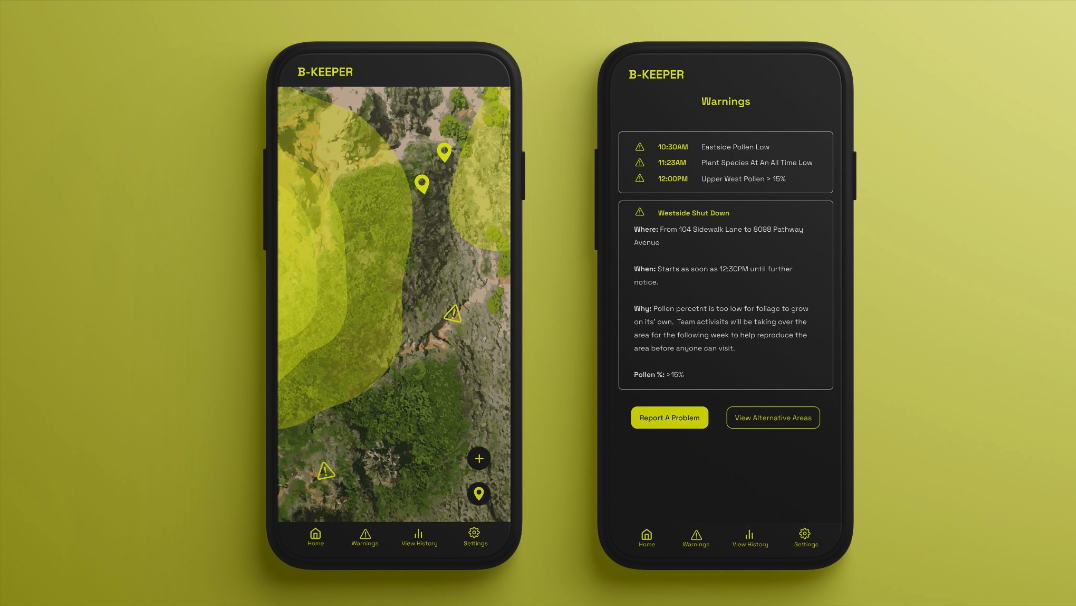
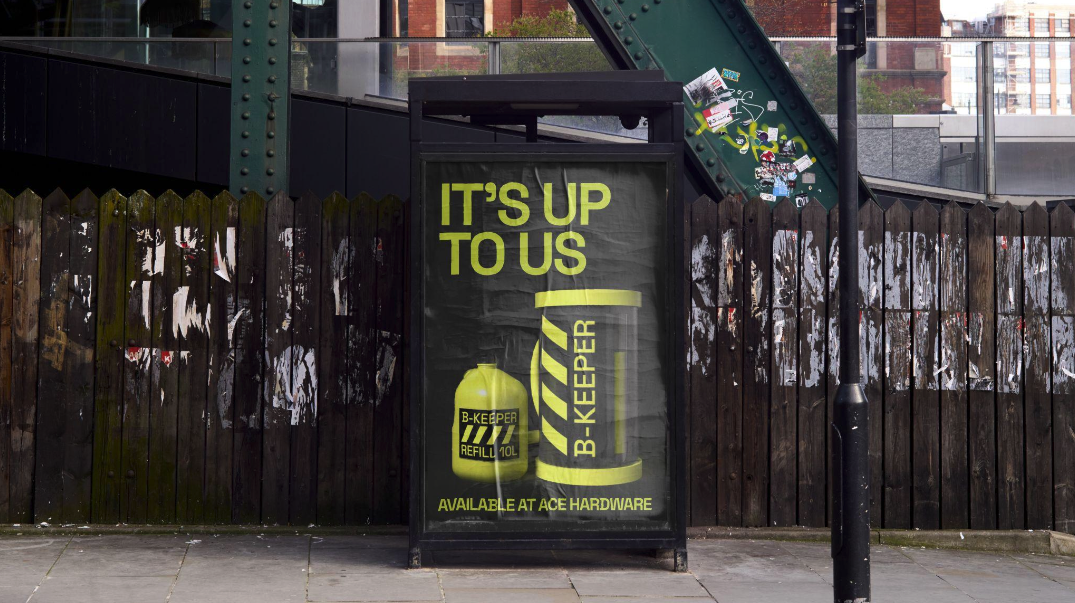
<p>Our design solution, B-KEEPER, is a Synthetic Pollen Application system for humans. Through continuous manual labor and a handy smartphone app, humans can maintain the delicate ecosystem and enjoy pollinating plants just like before!</p>
<p><img src="https://unfamiliaragency.neocities.org/assets/images/2026-04-03-16-24-35.png" alt="B-keeper mockup of tank and refill jug">
<img src="https://unfamiliaragency.neocities.org/assets/images/2026-04-03-16-25-00.png" alt="B-keeper mockup of person wearing system on back and carrying jug">
<img src="https://unfamiliaragency.neocities.org/assets/images/2026-04-03-16-26-35.png" alt="instruction card">
<img src="https://unfamiliaragency.neocities.org/assets/images/2026-04-03-16-26-55.png" alt="B-keeper phone app with map view">
<img src="https://unfamiliaragency.neocities.org/assets/images/2026-04-03-16-27-14.png" alt="weathered ad for B-keeper on a bus stop"></p>
This week I worked on completing a rough proof of concept for the driving/bidding/shopping game. This meant getting the functionality and physical inputs to work and not conflict with each other. My goal is to have all three interactions be simultaneous, without awkward pauses. This will create the most frantic and overwhelming experience.
Development Updates
I cobbled together a scrollable list of placeholder items that will eventually house the shopping part of the game. At first the scrollable list and the text input were fighting for focus – you had to click in and out of them, which was not ideal for the game. I eventually found a fix that keeps the focus in the textbox and just fakes the focus for the scrollable items. That will allow me to keep all the inputs separate for each part of the game and avoid conflicts.
Here’s a demo of the game while driving, scrolling items and typing numbers all at once-ish:
Physical Devices
Another bonus this week was finally receiving all my input devices from Amazon/eBay. Here are some notes on getting those set up:
USB Volume Knob
The knob worked right away when I plugged it in, which meant that it also controlled the volume up and down while using it in the game - definitely more frantic but not a great experience. I found a video in Mandarin (with English subtitles) that showed how to reconfigure the knob using a blank text file 🤯. I eventually got it working with the game by mapping the knob turns and clicks to F1, F2 and F3 keys (again, to avoid conflicts with other inputs and the text field). The knob will be used to scroll and click the shopping list.
10-Key Number Pad
This also worked as expected right away, as it’s a keyboard. Godot easily distinguishes between number pad keys and the top row numbers, so this will be easy to integrate. The 10-key will be used to enter bids for new mowing jobs, in a text/messenger like format.
USB Steering Wheel and Pedals
The most satisfying piece of equipment in this setup, the Logitech WingMan Formula GP is a USB steering wheel and pedal controller from around 1999 – 2000. It was also cheap enough on eBay that I could risk it not working with modern computers. To my surprise, the computer recognized it right away, but nothing was mapped to it. A short search led to Enjoyable, a homespun app for mapping controllers to other keys/mouse events:
27 years later, the wheel and pedals still work! They will drive the lawnmower and add another dimension of frustration with the foot controls.
Test Setup
Here’s a photo of the setup after getting it all working. My desk is too thick to clamp the wheel to it, so I’ll need to make some kind of jig or find a new table.
Up Next
Creating the behind the scenes mechanics (i.e. the guts of the game).
Creating lo-fi assets for each section of the game.
This week I began sketching and prototyping for Project 3, the perspective inversion exploration. I began by mapping out the qualities of my last few projects and their opposite polarities:
Recent Projects
Opposite Polarity
Non-commercial
Hyper-commercial
Reflective
Instinctual/guttural
Qualitative/Personal
Quantitative/Impersonal
Calm
Stressful
Non-goal oriented (Atelic)
Goal Oriented (Telic)
Present/Aware
Distracted
These help map out the end experience I want for the participant: overwhelming, stressful and impossible to manage. However, it also needs to be fun and engaging, at least at first – the player/participant must be willing to enter into the critical dialog in the first place. By embracing the hyper-quantitative and distracted qualities of interaction design, the intervention will aim to generate critical awareness by becoming increasingly terrible to participate in. I can really lean on my previous experience in UX and e-commerce for this project: just do the opposite of everything that's good and holy (or for the corporate-speak crowd: by leveraging worst practices).
My initial sketches for creating this experience involved using multiple, simultaneous points of interaction to create an impossible to manage, always out of control dynamic. After some more ideation, I landed on a concept of simultaneously trying to 1) mow lawns to earn money, 2) spend money buying trinkets online and 3) text with potential clients to line up new mowing jobs. If this was an arcade game, it could look something like this:
I committed to the approach buy purchasing a used USB racing wheel, a 10-key number pad and a USB volume spinner/button that will serve as the controls for the game. While I wait for those to arrive, I started testing prototype interactions in Godot. I got a little bogged down trying to figure out how all the game mechanics and systems would work together, which felt dispiriting. I jotted down some loose notes before deciding that I should just start coding the thing and I'd figure out the guts later.
My new goal for the week was to get something working in Godot and see if I can control multiple parts of the game/UI at the same time. I found a prototype that I made last summer while learning Godot: it's a top-down driving prototype for a car game. With a little moxie, it could also work as a mowing game. I added a number input and a text placeholder to try passing number values from the keyboard to the UI. So far everything is working, and the next goal would be to add a scrollable list of things for the shopping mechanics. Driving and typing numbers at the same time already feels impossible, so I think it's on the right track.
Thesis Prep Studio Project 3 involves finding new conceptual approaches to our thesis topic. The goal is to focus on problem-finding, critical prototyping and learning through making.
A lot of my work focuses on responding to and being critical of implicit biases, specifically those that drive us relentlessly towards linear growth, resource extraction and quantification. This usually involves inviting the participant to reflect on their own agency through non-commercial, atelic, reflective and/or presence-building interactions. These are offered as an alternative to the underlying 'default' forces that run much of our lives.
Instead of rejecting or attempting to counter those forces, what if we embraced them even harder? What if we ramp them up 10000X? How might we use the language, visuals and design of hyper-commercial, goal-oriented, quantitative growth to create a critical dialog? Rather than offering an alternative way of being/doing, this investigation will explore critical design by leaning in to the underlying biases and systems that I've previously been trying to counter.
MERGE is a co-creative experience rooted in communal sitting, interactive games and storytelling. Designed as an interactive exhibit, participants come together to create new constellations and tell original stories in an immersive environment.
This project began as a collaboration with Nadine Khoury, based on our previous thesis-related work. Communal floor-sitting and multiplayer interactive exhibits seemed to go hand in hand. Our initial explorations and sketching led to an interactive experience with four people seated around a large area, collaboratively creating something in the middle. This turned into a literal space (the cosmic kind), with the participants guiding space particles towards each other to co-create constellations.
The interactive experience eventually expanded into a full exhibit, with storytelling and communal sitting at the core. While creating the entire experience was out of scope, the prototype included a fully playable game, a 3D model of the space and an interactive pilot test in the Student Innovation Center.
This project involved creating a proposal for a creative inquiry engaging a temporary community. I focused on connecting two temporary communities:
The local community that formed in our neighborhood after the August 2020 Iowa Derecho
Present-day exhibit viewers playing a multiplayer videogame
The creative inquiry would involve creating an original interactive experience through which present-day players could experience stories and memories collected from the post-derecho community. The project would also explore interactive videogames within the gallery/exhibition context, investigating how shared interactive experiences can help us preserve, share and learn from past stories.
Framing this work as a proposal rather than a completed game helped us think through the logistics and scheduling for a multi-phase project. It also provided good experience articulating research goals and positioning creative inquiry alongside other academic research and externally funded avenues.
Our kickoff project in Thesis Prep Studio was a collaboration across cohorts, i.e. between 2nd year and 3rd year MFA students. Gabriella Goldstein and I were challenged with envisioning for a speculative future scenario and designing artifacts from that future.
We focused on a future in which all pollinating insects have gone extinct. Faced with a collapsing ecosystem, humans are faced with a choice: take up the invisible labor previously done by insects or starve to death. How might humans fill in the ecological roles previously assumed by insects?
Our design solution, B-KEEPER, is a Synthetic Pollen Application system for humans. Through continuous manual labor and a handy smartphone app, humans can maintain the delicate ecosystem and enjoy pollinating plants just like before!
This site is for documenting and sharing progress on my MFA Graphic Design thesis. unfamiliar agency is a working title and guiding theme for the project.
This project involved creating a proposal for a creative inquiry engaging a temporary community. I focused on connecting two temporary communities:
The local community that formed in our neighborhood after the August 2020 Iowa Derecho
Present-day exhibit viewers playing a multiplayer videogame
The creative inquiry would involve creating an original interactive experience through which present-day players could experience stories and memories collected from the post-derecho community. The project would also explore interactive videogames within the gallery/exhibition context, investigating how shared interactive experiences can help us preserve, share and learn from past stories.
Framing this work as a proposal rather than a completed game helped us think through the logistics and scheduling for a multi-phase project. It also provided good experience articulating research goals and positioning creative inquiry alongside other academic research and externally funded avenues.